

Direct answer
Gyazo metadata breach support data cost map: what CRM buyers should take from it
The Gyazo breach turns screenshot metadata into a support-ops cost issue. When image IDs, source URLs, IP addresses, user agents, OCR text, private-link material, login/session IDs, password hashes and SSO-related fields may be exposed, the workload is not only security remediation. Support teams need an inventory of image-bearing workflows, user-notice logic, token and password guidance, suspicious-message scripts, help-center asset checks and closure proof.
Published 9/23/2026. News event: 9/16/2026.
What happened
- Gyazo's September 16, 2026 notice said unauthorized access exposed some user information and metadata related to uploaded images.
- The notice said data relating to about 23.62 million Gyazo users was externally exposed, along with metadata for about 490 million images and an additional about 2.4 million image-metadata records under narrowed conditions.
- Gyazo listed possible exposed fields including email address, password hash, user ID, device ID, login session ID, subscription and billing status, X integration token where linked, and Google SSO email address where used.
- The notice said image metadata may include image ID, source IP address, User-Agent, EXIF location data when present, OCR text, image title, source URL and a hash of the passphrase for private images.
- Gyazo said it could not completely rule out that some private images were viewed by a third party, while payment card information was not exposed.
- Helpfeel's September 18 update said Helpfeel and Cosense run on separate system configurations, no information leakage from those systems had been confirmed, and emergency security checks were underway as a preventive step.
Why this is trending
- The numbers are large enough to make the incident visible beyond ordinary account-notice work.
- The exposed metadata categories matter to support teams because screenshots often contain ticket evidence, product context, customer environments, account workflows and operational timestamps.
- Even when payment cards are not exposed, image IDs, OCR text, source URLs, login/session IDs and integration tokens can create follow-up work for help desks, customer-success teams and security owners.
- Help-center and knowledge-base operations often reuse screenshots across articles, ticket macros, training decks and customer replies, which makes asset inventory part of incident response.
- The incident gives CRM and support buyers a concrete test: can their provider identify where customer screenshots live, how private links work, which tokens need action and what frontline staff should say?
The CRM Costs take
A CRM buyer should treat screenshot and knowledge-base image handling as a support-data workflow, not a casual attachment habit. Before approving a help desk, knowledge base, outsourced support process or AI assistant that reads ticket images, the buyer should ask for a Support Data Cost Map showing image inventory, private-link controls, OCR and metadata exposure, token and SSO actions, customer notices, suspicious-message guidance and closure evidence. Without that map, the support team inherits an image-data incident after the screenshots have already spread.
Support Data Cost Map
A CRM and support-ops buyer map for budgeting screenshot inventory review, private-link exposure, user notices, token rotation, customer scripts and incident closure proof.
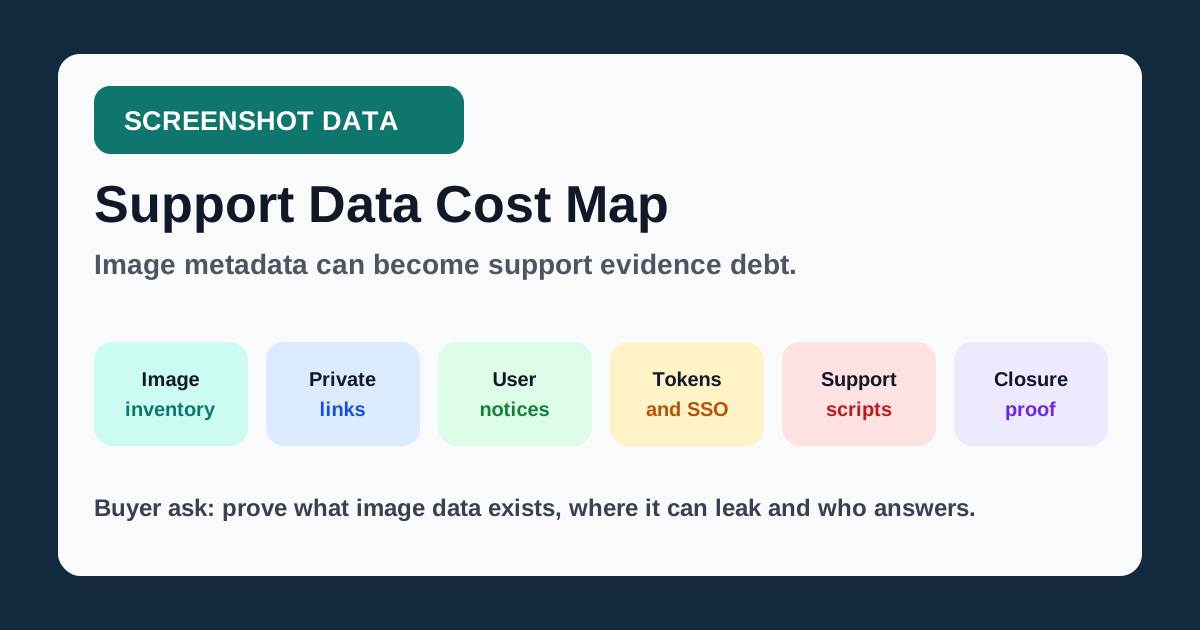
Create an image-asset register by system, owner, data category, retention period and customer visibility.
Review link construction, expiration, access logs, sharing permissions, takedown paths and customer-notice criteria.
Predefine notification scope, message owners, uncertainty language, suppression rules and evidence logs.
Rotate or restrict tokens, invalidate sessions where appropriate, warn on password reuse and review linked-account access.
Prepare approved scripts for affected fields, payment-card boundaries, suspicious messages, password guidance and escalation.
Close with a packet covering asset inventory, changed links, token actions, notices, inbound-case trends, QA samples and lessons learned.
What buyers should do next
Buyer FAQs
Were payment card numbers exposed in the Gyazo incident?
Gyazo's notice said payment information such as credit card numbers was not exposed. The support-ops issue is still significant because account fields, sessions, linked-account details and image metadata may require notices, guidance and follow-up.
Why is image metadata a support-operations cost?
Screenshots and uploaded images can carry image IDs, source URLs, OCR text, IP addresses, device context and location metadata. Support teams may need to inventory those assets, answer user questions, change links, rotate tokens and document closure.
What should CRM and helpdesk buyers ask providers now?
Ask for the image-asset register, private-link policy, screenshot-retention rules, OCR and metadata controls, token-rotation plan, user-notice workflow, suspicious-message script and closure-packet template.