

Direct answer
DIVD Zammad Breach Made Support Platform Exposure a Cost Gate: what CRM buyers should take from it
DIVD says its network was breached through an agentic AI powered attack that chained two Zammad vulnerabilities and led to data exfiltration. The practical support-ops lesson is not to treat a ticketing system as just another app. Buyers and operators should maintain a Support Platform Exposure Risk Map: every exposed instance, exact version and runtime status, service-account behavior, host privilege boundary, ticket-data egress path, preserved logs and emergency operating mode must have an owner and closure evidence.
Published 10/3/2026. News event: 10/1/2026.
What happened
- DIVD's case file says it detected suspicious activity on September 22, entered incident response, and later concluded that the attack had an agentic AI powered modus operandi.
- DIVD's September 30 statement says the attackers got in through two zero-days in Zammad that together enabled session hijacking, remote code execution and privilege escalation from the Zammad user to root.
- DIVD's October 1 update said volunteer data had been exfiltrated, including DIVD email addresses and possibly contact details, while the investigation remained open.
- The related DIVD vulnerability case identifies CVE-2026-102489 for Zammad remote code execution and CVE-2026-102490 for local privilege escalation, and advises Zammad users to upgrade to version 7 or take the instance offline while checking logs for compromise indicators.
- Sysdig's October 2 analysis summarized the same chain and framed the support-platform risk as an agentic threat actor moving from a hijacked session to root access in seconds.
- Zammad's community statement says current Zammad 7.0 and later are not affected by the CVE-2026-102489 exploitation conditions, recommends updating to Zammad 7.2.0, and says the local privilege issue cannot be exploited remotely on its own.
Why this is trending
- The incident connects three high-momentum buyer concerns: helpdesk exposure, autonomous attack speed and support-data exfiltration.
- Ticketing platforms sit close to customer records, attachments, credentials, support messages, volunteer or employee contact details and escalation workflows.
- DIVD's own transparency makes the operational sequence unusually visible: initial access, service-user execution, privilege escalation, data review and notification all landed in public case files.
- Sysdig's analysis turns the AI-agent angle into a detection problem: support platforms should not spawn shells, download tools or switch effective user identity without a high-confidence alert.
- The vendor statement adds an important buyer discipline: operators need exact version, runtime and advisory evidence, not a vague claim that a product is patched.
The CRM Costs take
Support and CRM teams should not wait until a ticketing platform is named in a CVE before mapping exposure. The same checklist applies to self-hosted helpdesks, CRM portals, ticket intake, live-chat backends and workflow automation servers. An emergency response should answer six buyer questions: what is exposed, which build is running, what can the app user do, what can become root, what data could leave, and what logs survive after the fix.
Support Platform Exposure Risk Map
A support-ops buyer map for helpdesk exposure, exact version proof, service-account boundaries, host privilege, data egress, preserved logs and emergency operating mode.
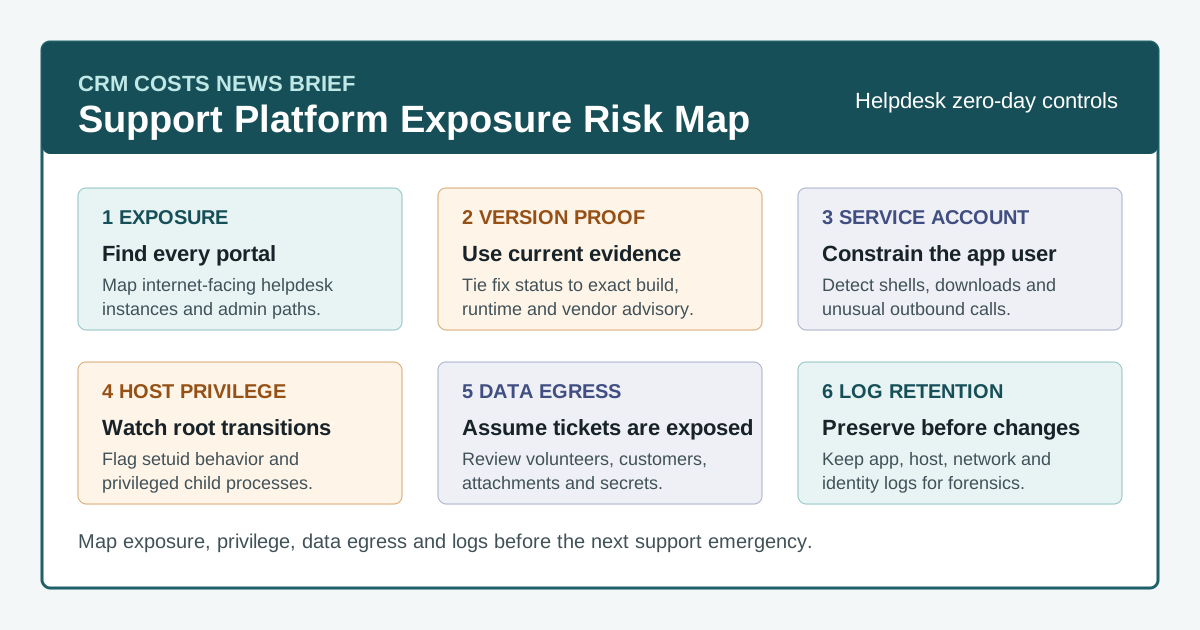
Inventory public hostnames, admin paths, network boundaries, instance owners and emergency shutdown criteria for every support platform.
Record before and after versions, current stable target, advisory notes, fix limitations and the person who accepted residual risk.
Profile normal process behavior, alert on shells and downloads, and restrict outbound access from the application service account.
Monitor setuid behavior, root-owned children, privileged path writes and namespace changes from the helpdesk user.
Classify support data, isolate sensitive attachments, remove secrets from tickets and prepare notification scripts by data category.
Copy application, web, authentication, process and network logs before changes; preserve hashes and run the current compromise checks.
What buyers should do next
Buyer FAQs
Does this prove every Zammad instance is compromised?
No. The public record describes DIVD's incident and the reported Zammad vulnerabilities. Buyers should verify their own exposure, version, runtime conditions, logs and vendor guidance before drawing conclusions.
Why is this a support-ops story rather than only a security story?
Helpdesk and ticketing systems hold support conversations, contact details, attachments, credentials, internal notes and escalation workflows. When that platform is the entry point, customer operations and incident response become the same control problem.
What should buyers ask first?
Ask for the exact exposed instances, current version and advisory status, preserved log evidence, service-account restrictions, support-data inventory and emergency operating plan.