

Direct answer
AI callers customer service authentication cost map: what CRM buyers should take from it
AI callers are now a support-operations cost gate because they can sit on hold, repeat requests, probe routing paths and reach agents without the context required to pass normal identity checks. Buyers should not treat every suspected AI caller as a normal customer call. They need an AI Caller Authentication Cost Map: detection, delegate authority, task boundary, QA scoring exemption, route-discovery logging and a verified agent channel for low-risk requests.
Published 9/29/2026. News event: 9/24/2026.
What happened
- Business Insider reported on September 24 that AI agents are being used to call customer-service lines, wait on hold, negotiate bills and cancel subscriptions while the person or business they represent does not handle the call directly.
- The report described a California insurance claims representative receiving repeated calls from the same AI agent on behalf of an accident-attorney firm, with the bot unable to answer normal intake questions and the human required to stay on the line until it disconnected.
- Business Insider also reported that the representative's employer used an AI quality model that could mark the human down for not being accommodating enough to the bot, creating manual appeal work.
- The article said TTEC's quality assurance team began noticing odd-sounding inbound voices about a year and a half earlier and later determined that some were AI.
- A credit-card retention representative in the reporting said AI callers were relatively rare but sometimes appeared to be mapping how to reach a live representative, while only the account holder could complete sensitive actions such as closing a card.
- State of AI's September 26 synthesis framed the issue as a contact-center policy problem: metrics, authentication and retention scripts were designed for human callers, not persistent software delegates.
Why this is trending
- Consumer-facing agent products are making outbound calls easier: TechCrunch reported this month that Instinct added Concierge calling and Meta's Muse added calls to U.S. businesses.
- Google's Gemini support documentation now describes a phone-calling feature that can ask businesses for hours, quotes, appointments and hold-time navigation while disclosing it is an AI assistant.
- Google's September 24 Gemini Agentic Calling terms show how much policy surface is needed even for a limited consumer feature: identity disclosure, accurate caller information, personal-use limits and prohibited uses.
- Accenture's 2026 consumer survey found that 74% of consumers would delegate routine tasks such as deal negotiation or complaint resolution to an AI agent if it acts on instruction.
- Gartner has also reported that customers increasingly expect AI to help complete service tasks, not merely answer questions, which raises pressure on support teams to handle action-oriented delegates.
- The practical result is that support leaders need to know whether a call came from a person, an authorized agent, a probe, or a fraud attempt before using it in staffing, QA and vendor-performance data.
The CRM Costs take
Support operations teams do not need to ban every AI caller to control the cost. They need to stop mixing machine-placed calls into human-customer metrics and stop letting phone identity questions absorb unlimited handle time. The defensible path is a policy by risk: accept low-risk status checks through a verified agent lane, require proof of authority before account changes, keep high-risk tasks with the account holder, and exempt suspected machine calls from empathy scoring until the company can prove who or what was on the line.
AI Caller Authentication Cost Map
A support-ops buyer map for separating AI callers from human customers, verifying authority, protecting sensitive tasks, adjusting QA metrics and building a verified delegate channel.
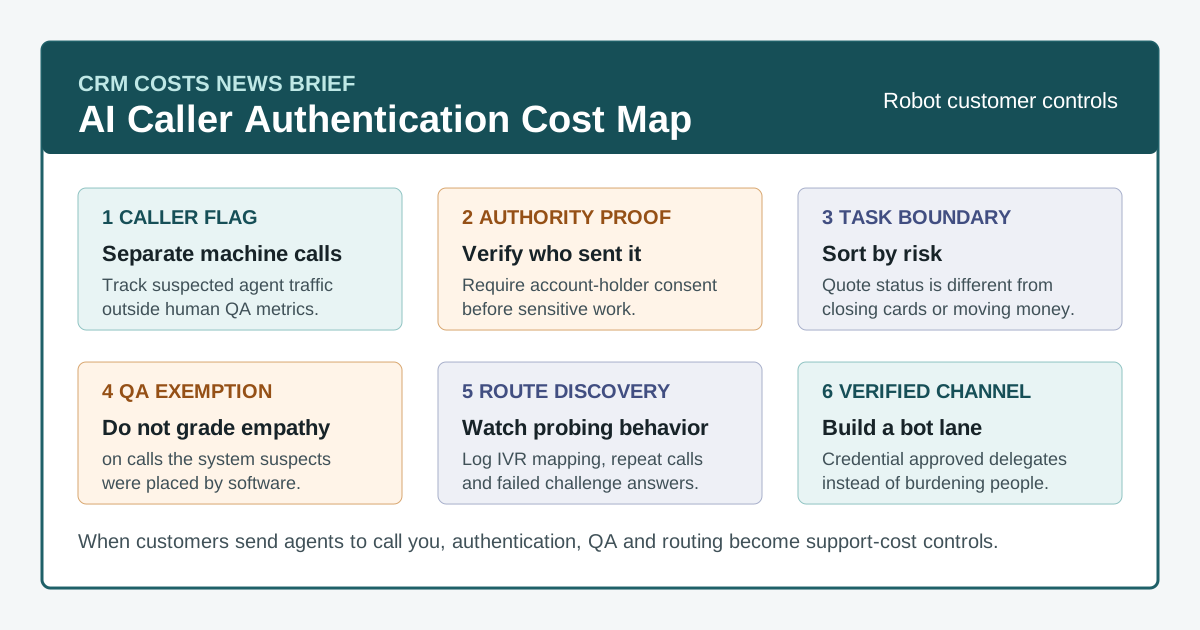
Add suspected-agent disposition codes, call recordings review rules and separate reporting for machine-placed calls.
Require pre-registered delegates, one-time authorization, callback to a trusted channel or account-holder confirmation before sensitive work.
Classify call intents by risk, allow low-risk information checks, and block account changes, money movement, regulated data and cancellation without stronger proof.
Exclude suspected AI-caller interactions from empathy scoring or route them to a separate rubric focused on policy adherence and authentication.
Log route-probing patterns, throttle repeat callers, review recordings, and move suspicious attempts into fraud or abuse monitoring.
Pilot a registered-agent workflow with narrow scopes, explicit customer consent, rate limits, transcript retention and human fallback.
What buyers should do next
Buyer FAQs
Should support teams reject all AI callers?
Not automatically. A delegated AI caller asking for business hours or appointment availability is different from one trying to close an account, move money or access regulated data. The safer approach is to classify requests by risk and require stronger proof for sensitive actions.
Why do AI callers affect support costs?
They can create handle time, repeat contacts, manual QA appeals, fraud-review work and extra authentication steps. If the reporting system treats those calls as normal customer contacts, staffing and vendor-performance decisions can become distorted.
What should buyers ask vendors now?
Ask whether the platform can tag suspected AI callers, separate QA scoring, log route-probing behavior, verify delegated authority, throttle repeat machine calls and support a credentialed low-risk agent channel.